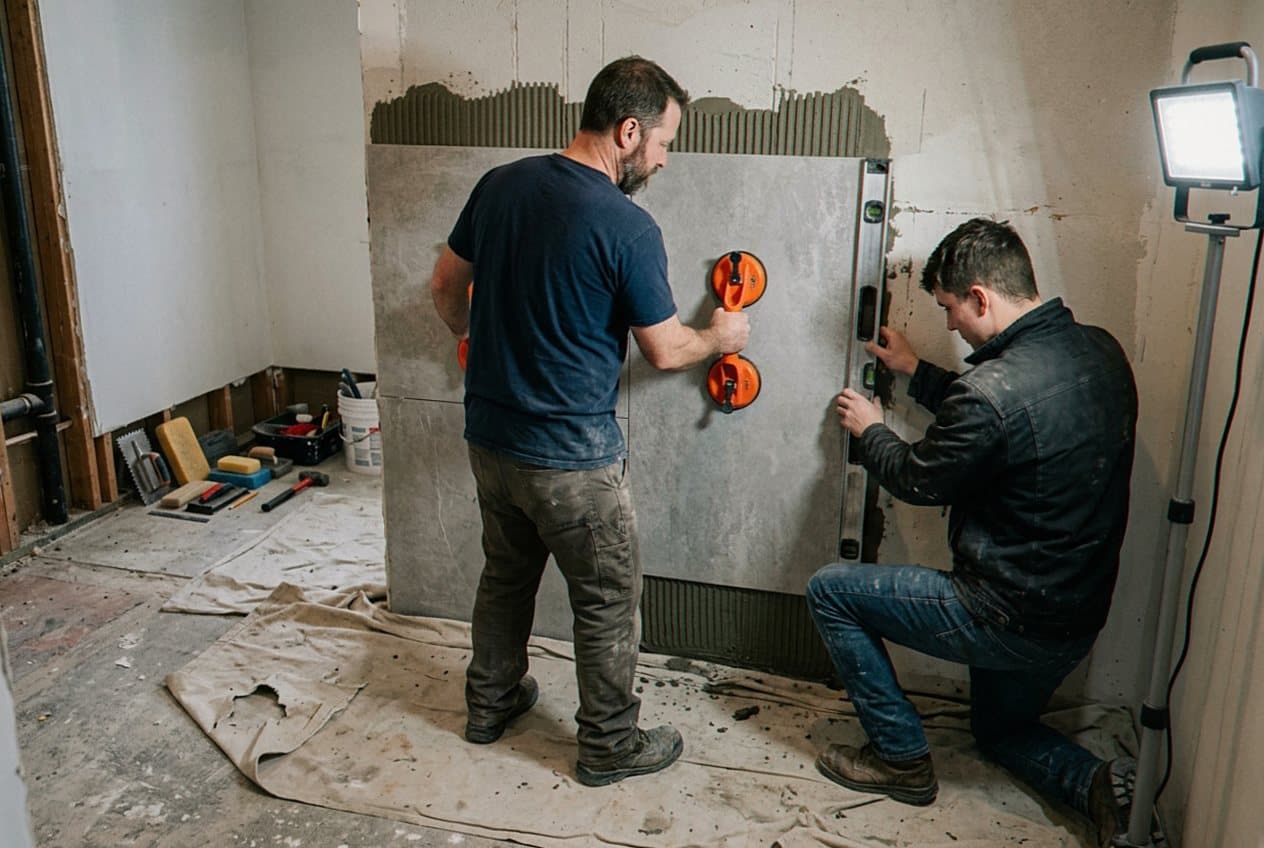
Big tile set flat by our own crew
Big tile is unforgiving, and that one fact shapes the whole job. A tile running twenty four inches or longer on a side cannot bend. It will not follow a floor that rolls, and it will not forgive a wall that wanders off. Set a small square over a dip and the grout joints swallow the error. Set a big plank over that same dip and one corner rises above its neighbor. You feel that edge with a bare foot every time you cross the room, and once you have felt it you never stop feeling it. So the first thing our crew does in a Sterling Heights house is find out how flat the floor truly is. We drag a long straight edge across the room both ways and along the diagonals. Every low spot gets chalk on it. The trade even has a number for this. On tile with any side over fifteen inches, the floor is supposed to sit within an eighth of an inch across ten feet. That is tighter than most houses in Macomb County were ever built to, which is why prep eats the front of the job. Most floors here need help. The brick ranches off Dodge Park and Utica Road went up in the fifties and sixties, and sixty seasons of wood swelling and drying have left the subfloor with a slow roll that carpet hides completely. Colonials from the seventies and eighties carry longer joist spans, so the middle of a room can sit a quarter inch below the walls without anybody noticing. Basement slabs are their own story. A slab poured in a hurry in 1968 is rarely flat, and nobody ever checked it, because carpet and vinyl do not care. We tell you what we find before we quote the work, not after. Sometimes the answer is a leveling pour across the whole room. Sometimes it is patching four spots and getting on with it. Either way that step is not optional under big tile. A crew that skips it hands you a floor that photographs beautifully and bothers you in person for the next fifteen years. Flatness is the real job here. The tile is only what goes on top of it.
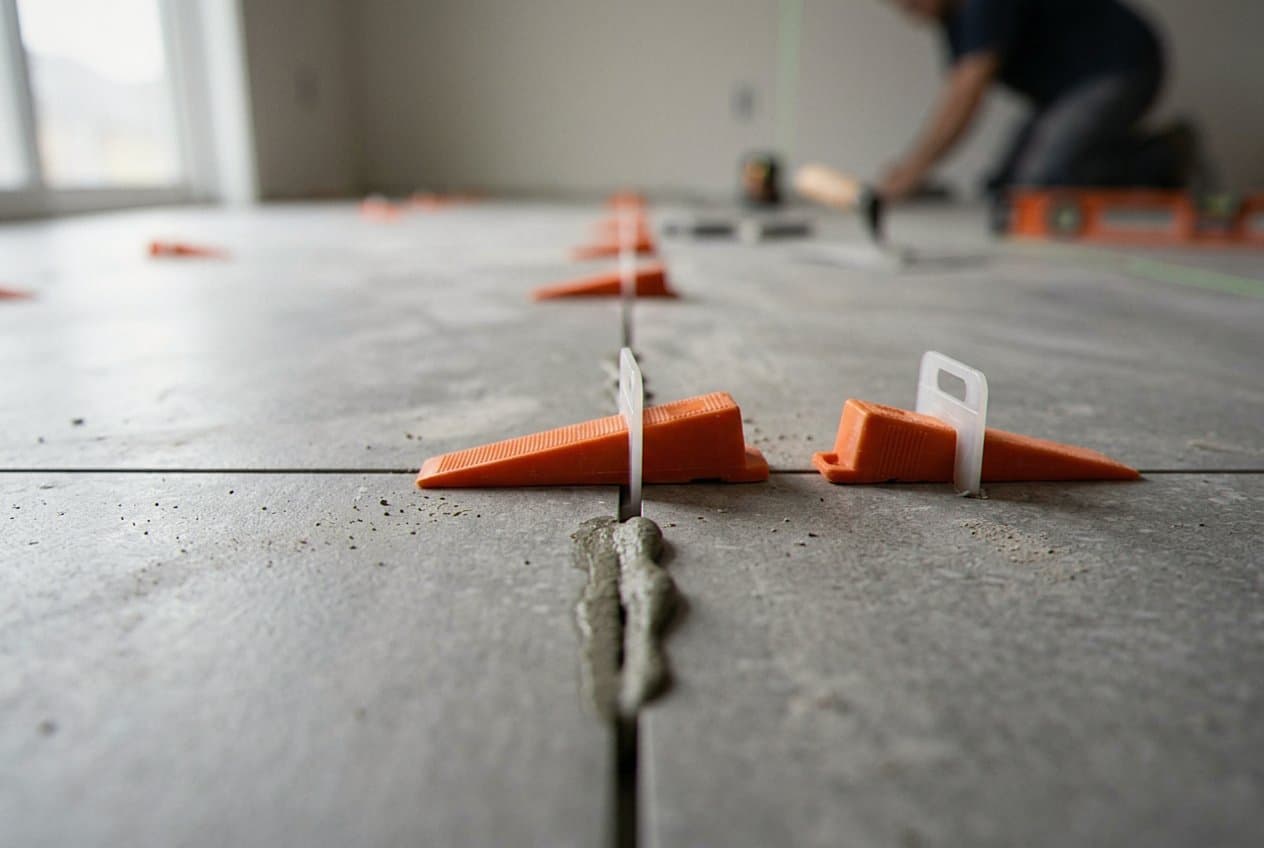
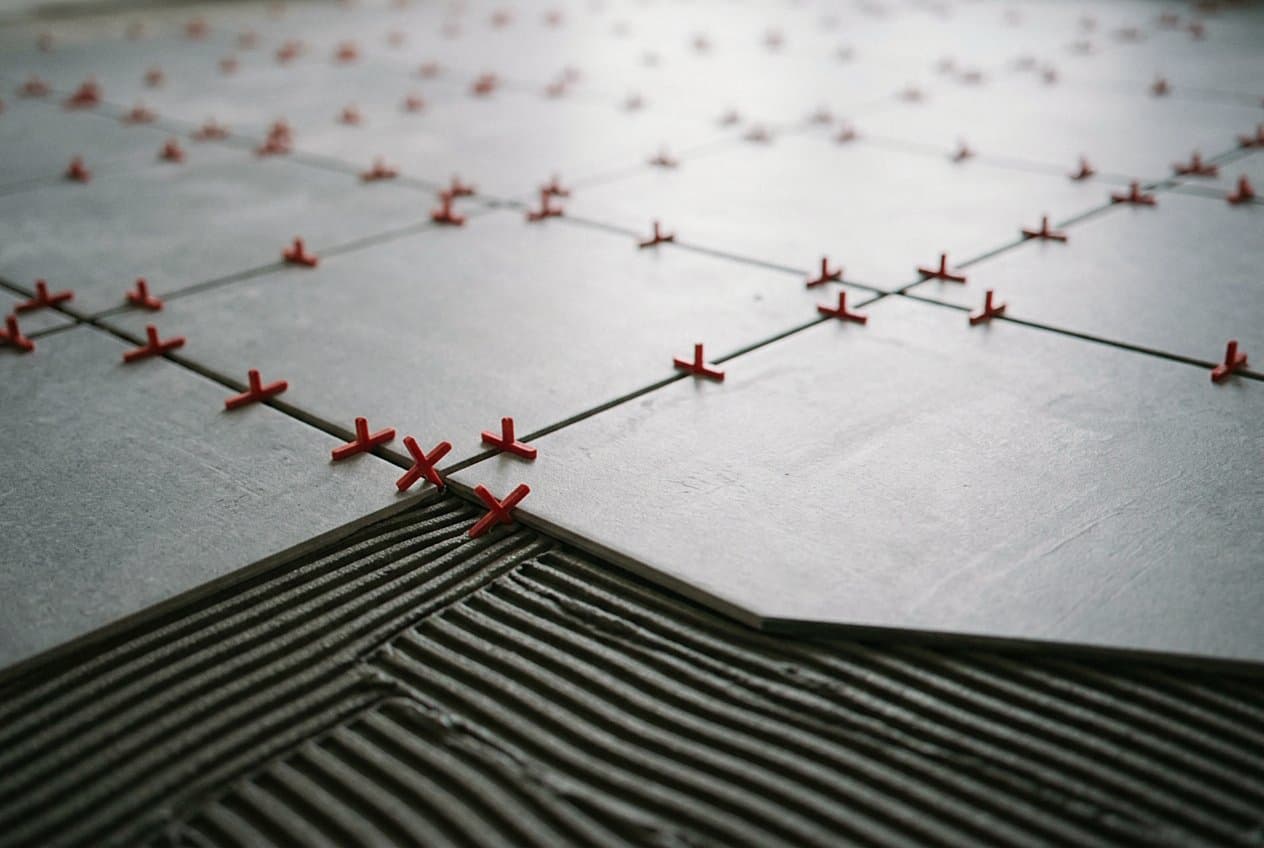
Once the floor reads flat under the straight edge, the rest is layout and patience. We start by finding the longest sight line in the room instead of squaring off a wall, because walls in a settled house will lie to you. A quarter inch of bow across twelve feet is ordinary around here. On a big tile floor that bow turns into a tapered sliver of a cut along the baseboard, and you will look at it for years. So we snap our lines off the sight line, dry lay a run straight down the middle, and walk you through where every cut lands before any mortar leaves the bucket. Pattern matters more than people expect it to. A plank tile set in a straight half offset will show a lifted edge at nearly every joint, because a long tile almost always carries a slight crown through its middle. We set planks at a third offset instead, which puts the high point of one tile against the flatter part of the next one. Square tile usually goes down in a straight stack or a plain grid, since a large tile carries a room by itself and does not need a busy pattern helping it along. Then we set. Each piece gets mortar combed out on the floor and a thin skim spread on the back of the tile, so the bed underneath is full and no hollow pockets are left waiting to crack a corner later. We work leveling clips into the joints while the mortar is still soft. Those clips pull neighboring edges into the same plane and hold them there overnight, which is how a floor ends up smooth enough to run a hand across. We keep the grout joints a little wider than most people picture, usually an eighth of an inch or better, because a big tile is never perfectly square and the joint is where that difference goes to hide. Where the field meets a wall, a tub, or a doorway, we leave a soft joint rather than packing it stiff. The house has to move through a dry January and a sticky July, and that gap is what lets it. Then we grout, wipe the haze, set the transitions, and carry our mess out with us.
- We measure how flat your floor is before we quote a number. Then we tell you plainly what it takes to get it inside the range big tile needs. No pretending a rolling subfloor is fine. No surprise leveling charge landing on you after the old floor is already in the dumpster.
- Every tile gets mortar combed on the floor and a thin skim spread on its back. That fills the bed edge to edge. A full bed is what keeps a corner from cracking when a heavy pan hits it, and it is why our floors do not sound hollow when you tap one.
- Leveling clips go into the joints while the mortar is still soft. They pull the edge of one tile even with its neighbor and hold it there overnight. That is the whole difference between a floor your palm glides across and one that catches a bare toe at every seam.
- We snap the layout off the longest sight line in the room, never off a crooked wall. On big tile that choice decides how the floor reads. It pushes the odd tapered cuts under a toe kick or behind a door, and it leaves the open part of the room looking straight.
- The crew that walks your house is the crew that sets your tile. Nothing gets handed off and explained twice. We settle pattern, offset, and grout color with you before any underlayment goes down. Then you see a dry laid run on your own floor before a single piece is stuck to it.
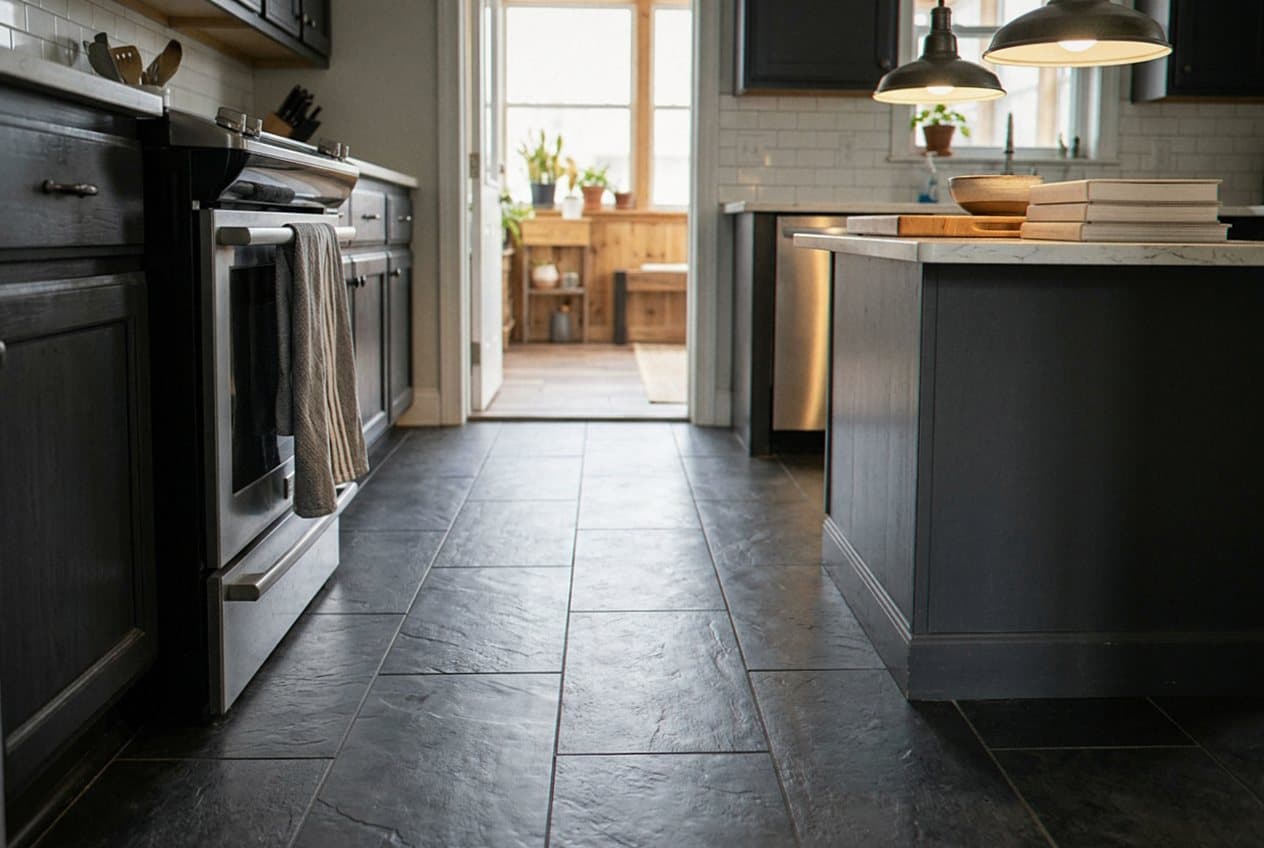
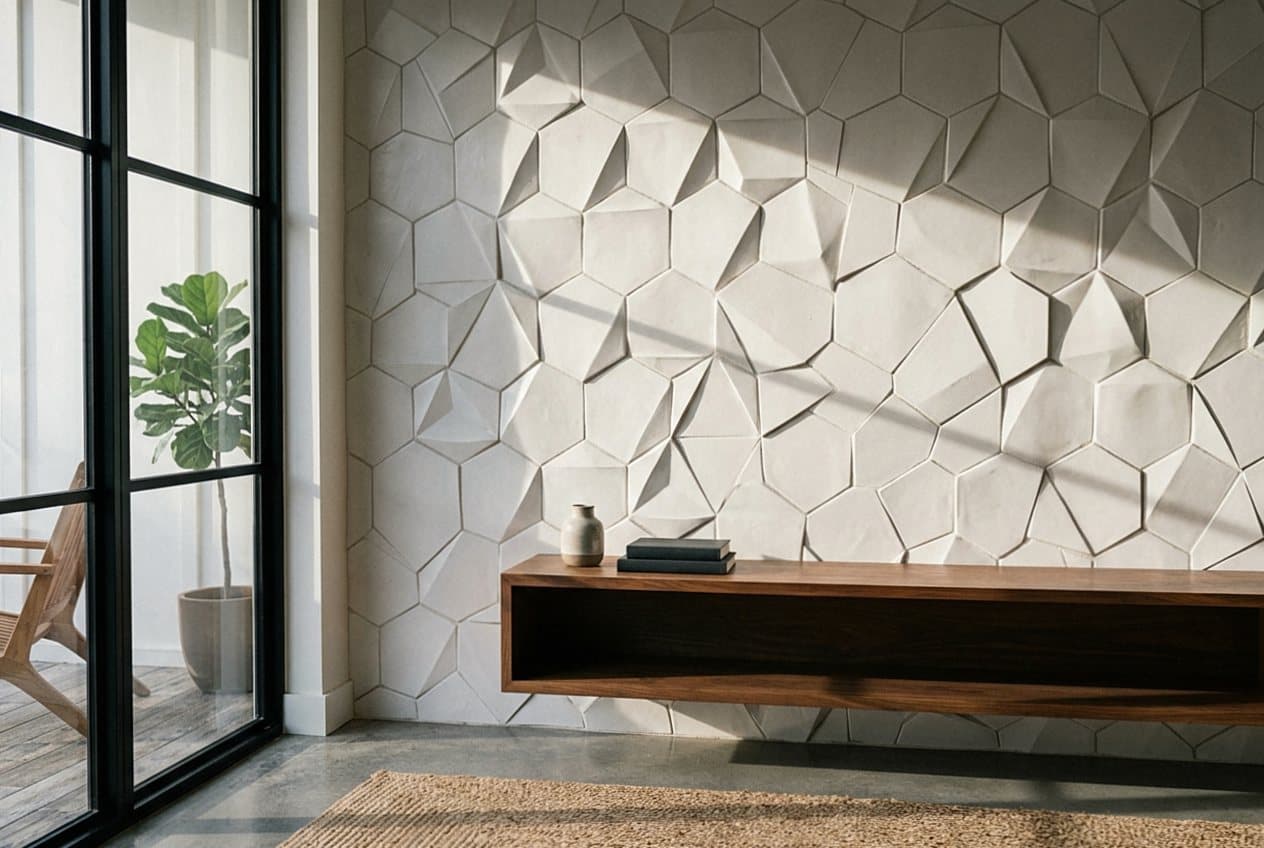
The sizes keep growing, and the reason is simple. Fewer joints reads calmer, and it cleans easier. A kitchen floor in twelve by twenty four porcelain has roughly half the grout of the same room in twelve inch squares, so there is half as much to scrub and half as much to go dingy near the stove. Most of what we set is porcelain, because it barely absorbs water and it shrugs off the salt and slush that ride in on boots from November into March. Plank shapes that read like wood are the busiest request we get. They give a mudroom off the garage the warm look of a board floor in a spot where real boards would swell and cup by the second winter. Then there are the thin panels, the ones that come in sheets several feet across. Those belong on a shower wall or a fireplace face more than a floor, and setting them takes two people, suction handles, and a slow morning. We are honest about where they are worth the trouble. Finish deserves a word too. A polished big tile in a Sterling Heights bathroom looks stunning dry and turns into a skating rink under wet feet, so we steer people toward a matte or a lightly textured face in any room where somebody steps out of a shower. Grout color changes the whole feel as well. Match the grout close to the tile and the floor reads as one quiet surface, which is usually the point of going big. Push the contrast and every rectangle stands up and announces itself, and on a floor this size that can get loud fast. We bring samples to the house rather than asking you to decide at the shop. Store lighting is bright and white and nothing like a Macomb County living room in February, when the sky sits low for weeks and one window is doing all the work. A tile that looked warm under the showroom lamps can go flat and gray in your hallway. Seeing it on your own floor, next to your own cabinets, at four in the afternoon, settles the question in about ten minutes.
Thinking about big tile in Sterling Heights, Utica, Shelby Township, Clinton Township, or anywhere else around Macomb County? Call us and we will come look at the room. We put a straight edge on your floor while we are standing there, so you hear what the prep really involves before you hear a price. We go through sizes, offsets, grout color, and where the cuts will land. Then you get a straight number and all the time you want to think it over. Nobody is going to lean on you in your own kitchen. Most jobs get on the schedule within a couple of weeks, and we tell you up front if a leveling pour needs a day to cure before the tile can go down.